Retro Games Online – Play Classic Console Games Free
Zoom
Zoom — overview
Zoom is a classic retro action game released for sega-mega-drive-genesis. Many players remember it for its atmosphere, distinctive level design and the specific feeling of that era. Below you will find a detailed breakdown of gameplay, structure, secrets and interesting facts that will help both nostalgic players and newcomers better understand this title.
Development background and release
When Zoom appeared on the market, home consoles were rapidly evolving, and developers experimented with genres, technical tricks and new ways to keep players engaged. Even if the project did not become the most famous hit of its generation, it formed a small loyal audience that still remembers specific details, stages and moments.
According to various interviews and retrospectives, games of this period were created by compact teams that combined programmers, artists and sound designers who often worked under tight deadlines. Because of this, many design decisions in Zoom feel pragmatic: content is reused smartly, enemies appear in patterns and locations are built around clear gameplay ideas rather than pure visuals.
Gameplay structure and core mechanics
The gameplay loop in Zoom is based on a combination of exploration, combat and constant small decisions that the player has to make on the fly. Typical sessions last from a few minutes to half an hour, but each run can feel different thanks to enemy placement, item distribution and the way the player learns from mistakes. The first levels usually act as an expanded tutorial: they introduce controls, basic enemies and show how hazards work without explicitly explaining every detail in text.
As the game progresses, the difficulty curve becomes steeper. Later stages punish careless movement, force you to memorize safe routes and pay attention to timing. Boss encounters often serve as short exams where the player has to demonstrate understanding of core mechanics: spacing, dodging, resource management or use of special abilities. Because of this, Zoom can feel demanding but fair when you approach it with patience.
Level design and progression
Level layouts in Zoom usually follow a clear structure: a starting area that sets the tone, a middle section with higher density of enemies or traps, and a final segment that prepares the player for a boss fight or transition to the next environment. Many rooms or corridors are deliberately narrow to control pacing and force the player to commit to their decisions. Secret zones, alternative routes and optional encounters are placed slightly off the critical path, encouraging curious players to take risks in exchange for extra resources or power-ups.
The visual themes of locations change gradually: industrial complexes may shift into underground tunnels, city outskirts or more abstract final areas. Even with limited memory budgets of the original hardware, creators managed to vary colour palettes and background details enough so that returning players can instantly recognise key places purely by silhouette and layout.
Graphics, sound and atmosphere
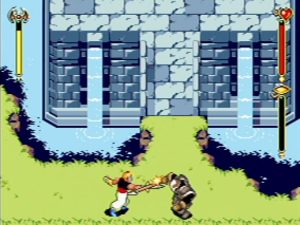
Technically, Zoom uses tricks typical for sega-mega-drive-genesis: limited palettes, tile-based backgrounds and sprite-based characters with relatively small sets of frames. Instead of chasing realism, artists focused on readability — silhouettes of enemies and interactive objects stand out clearly against the background, which is crucial during intense scenes.
The soundtrack plays a huge role in how the game feels. Looped tracks, built from a small set of channels, create a sense of tension and rhythm that motivates the player to keep moving forward. Sound effects emphasise hits, jumps, shots and ambient elements; even simple beeps and clicks can become strongly associated with specific actions after a few play sessions.
Secrets, hidden elements and replay value
Like many retro titles, Zoom rewards players who go beyond the obvious route. Hidden items may be tucked behind fake walls, placed at the edge of platforms that look dangerous, or appear only if the player fulfils certain conditions. Some versions of the game contain region-specific differences: changed difficulty, altered enemy positions or small cosmetic tweaks in backgrounds and interface.
Because of these nuances, fans of Zoom often replay the campaign multiple times, trying to optimise their route, reach optional rooms or complete personal challenges such as no-damage runs. In the context of modern game design, this kind of replay value feels very pure: the game does not rely on artificial progression systems or external rewards, only on mastery of mechanics.
FAQ and useful tips for players
How difficult is Zoom for a new player?
At first, the game can feel challenging, especially if you are not used to older sega-mega-drive-genesis projects. However, after several attempts most players adapt to the pace, learn patterns of enemies and gradually progress further with each run.
Do I need a detailed guide to complete the game?
A full step-by-step guide is not strictly necessary. Most stages can be cleared with careful exploration and attention to visual hints. If you get stuck, looking at a map of the level layout or short text guides from the community can significantly simplify progress.
Is Zoom interesting for players who never owned the original hardware?
Yes. Even without nostalgia, the game offers a snapshot of how action and retro action design worked on retro systems. Many modern players discover such projects through browser emulation and appreciate the focused, undistracting structure of old-school levels.
How long does it take to finish the game?
Exact completion time depends strongly on skill, but on average a first playthrough may take several hours spread across multiple sessions. Skilled players who know the maps and enemy behaviour can complete Zoom much faster, especially if they use advanced strategies learned over time.
Why revisit Zoom today?
Revisiting Zoom is a way to experience a compact, mechanics-driven game without excessive tutorials or meta-systems. It shows how designers of the sega-mega-drive-genesis era solved problems of pacing, difficulty and visual clarity with limited tools. For fans of retro gaming, this title is also a piece of history that helps understand how the genre evolved.